Mthimkulu Nature Reserve was established in 2025 as a newly protected area contiguous with Kruger National Park, one of Africa’s most significant protected ecosystems. Its location connects it directly into the open systems of the Greater Kruger, making it part of one of the largest continuous conservation landscapes on the continent.
Over the past decades, the reserve has seen extensive poaching pressure, severe overgrazing, and years without established land management protocols. Our research and restoration program exists to address these conditions directly, building the structured, data-driven foundation the reserve needs to recover.
The datasets we generate, including vegetation baselines, species inventories, and predator presence records, contribute substantially to the reserve’s overall restoration and help guide how the land is managed going forward.
Strategic Location
Western boundary of Kruger National Park, enabling unhindered wildlife movement across the Greater Kruger ecosystem.
Ecological Restoration
Intensive habitat restoration responding to a legacy of poaching, overgrazing, and degraded land management.
Legislative Compliance
Adherence to local frameworks for invasive species removal and ecosystem restoration.
Shared Governance
African Impact holds a seat on the management board and research informs real ecological strategy.
Greater Kruger, Limpopo Province
Mthimkulu sits on the western boundary of Kruger National Park, at the confluence of the Big Letaba River system — a strategic position within one of Africa’s largest contiguous conservation areas.
Mthimkulu Game Reserve
Kruger National Park reference
Big Letaba River
Coordinates approximate — based on Greater Kruger western boundary
6,500
ha
Reserve area
~24°S
Latitude
Limpopo
Province
Greater Kruger
Ecosystem
Letaba River confluence
Mthimkulu is situated between two contrasting river systems: the perennial Groot Letaba River along its southern boundary and the seasonal Klein Letaba River to the east. Together, these rivers serve as a critical water source for wildlife, driving cycles of movement, creating important habitat variation across the reserve and providing opportunities for future research into seasonal ecological processes.
Letaba River confluence
The perennial Groot Letaba River forms the southern boundary of the reserve and provides an important year-round water source for wildlife. Its riverine habitats contribute to the ecological diversity of the reserve and provide opportunities for future water and aquatic ecosystem monitoring.
Klein Letaba River
The Klein Letaba River transforms the landscape’s ecological tempo. Its seasonal cycles influence vegetation growth, wildlife activity and the availability of water across the landscape, creating fluctuating conditions that make Mthimkulu an exceptional site for long-term, seasonally comparative research.
Big Five & Wildlife Diversity
Mthimkulu forms part of the wider Greater Kruger landscape, with the potential to support a diverse assemblage of wildlife, including elephant, lion, leopard, buffalo and rhinoceros, alongside smaller predators, herbivores, birds, reptiles, amphibians and invertebrates. Its open connection to the surrounding landscape means wildlife movement through the reserve is possible across seasons and changing environmental conditions.
Our research program provides an opportunity to systematically document wildlife presence, distribution and ecological patterns over time, building a long-term understanding of the reserve’s biodiversity.
Life in the field
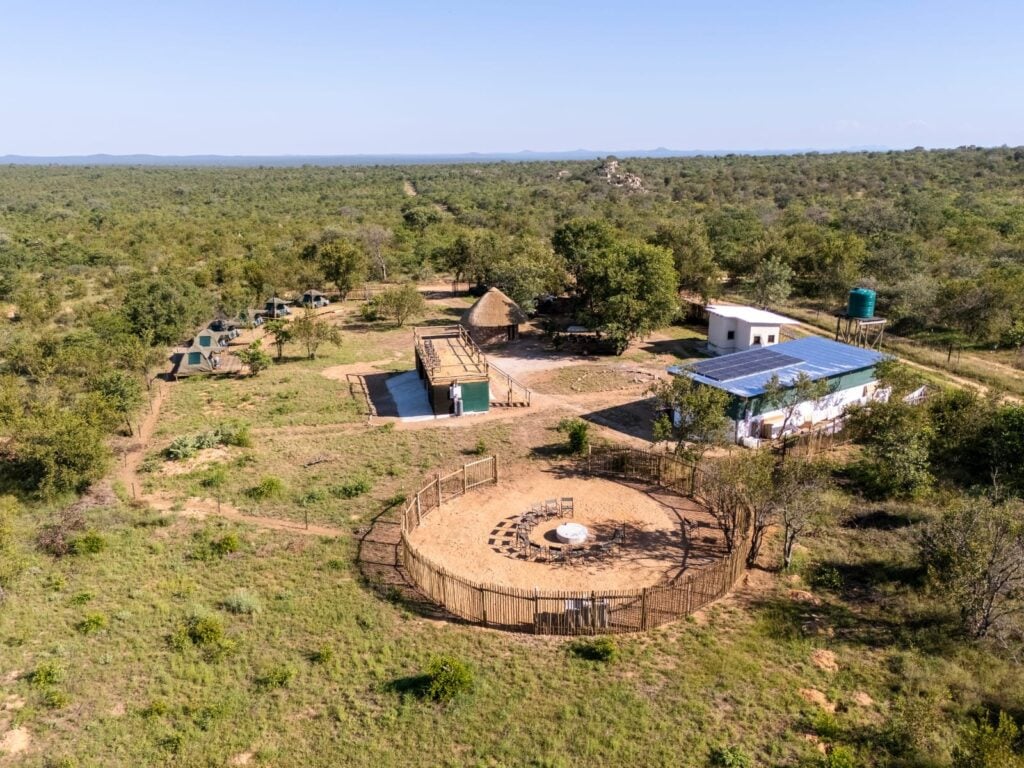
Our camp at Mthimkulu is a traditional bush-style setup within the reserve boundary. Accommodation is in thatched rondavels and safari tents on raised decking.
Evening sessions follow dinner and include conservation lectures, species identification, and structured data review. The campfire provides a consistent debrief setting where field observations are discussed in the context of broader ecological questions.
This residential field station model — living alongside the ecosystem being studied — is central to the depth of learning the program achieves.
Join The Program
School programs
Field-based ecological learning for high school and IB CAS groups.