
Research Program
Ecological restoration & conservation management
Our research program brings students and scientists together to do multifaceted field research. It’s a vital first step towards restoring this land as an ecologically balanced wildlife haven.
In a collaborative effort with university and school groups, our team of scientists is building a longitudinal dataset that feeds into management decisions: where to focus restoration, how wildlife populations are responding, how the landscape is changing.
Data collected is submitted to reserve ecologists, and where relevant, contributed to regional and national biodiversity platforms including SABAP2, the Southern African Bird Atlas Project.
Research Verticals
Student groups contribute to nine interconnected areas of ecological research and monitoring. Data collected contributes directly to ongoing reserve management and conservation planning.
Long-Term Conservation Impact
Each activity is designed to produce measurable outcomes that feed directly into adaptive reserve management.
| Program | Measurable Data Produced | Research & Management Value |
|---|---|---|
| Habitat & Vegetation Monitoring | Vegetation observations, species records, survey locations, habitat condition data and photographic records | Establishes habitat baselines and supports monitoring of vegetation composition, structure and change |
| Habitat Restoration & Conservation Management | Restoration effort, areas treated, road-clearing distances, invasive species records, snares removed, trees protected and photographic records | Documents conservation effort and helps identify priorities and evaluate management activities |
| Elephant Ecology & Monitoring | Individual elephant identifications, sightings, group observations, behavioral records and tree-impact records | Builds a long-term elephant dataset and supports understanding of elephant distribution, behavior and impacts on vegetation |
| Carnivore Monitoring | Camera-trap records, species detections, spoor records, sightings, den-site observations and bait/scent-station records | Builds baseline information on carnivore presence, distribution and activity |
| Mammal Monitoring | Mammal sightings, species records, game-count observations, camera-trap records and den-site activity | Establishes baseline mammal diversity and occurrence and supports long-term monitoring of wildlife populations |
| Bird Monitoring | Monthly SABAP2 records, cumulative species lists and GRIN raptor observations | Contributes to established biodiversity datasets and builds a long-term record of bird and raptor diversity and occurrence |
| Invertebrate Monitoring | Species records from pitfall trapping, butterfly surveys and nocturnal UV trapping | Establishes baseline invertebrate diversity and provides a foundation for future monitoring |
| Reptile & Amphibian Monitoring | Species observations, locations, habitat records and amphibian call records | Establishes baseline reptile and amphibian diversity and distribution |
| Water & Soil Monitoring | Water-quality measurements, aquatic macroinvertebrate records and soil-condition data | Establishes baseline environmental conditions and provides a foundation for future ecosystem and restoration monitoring |
Field Data Processing
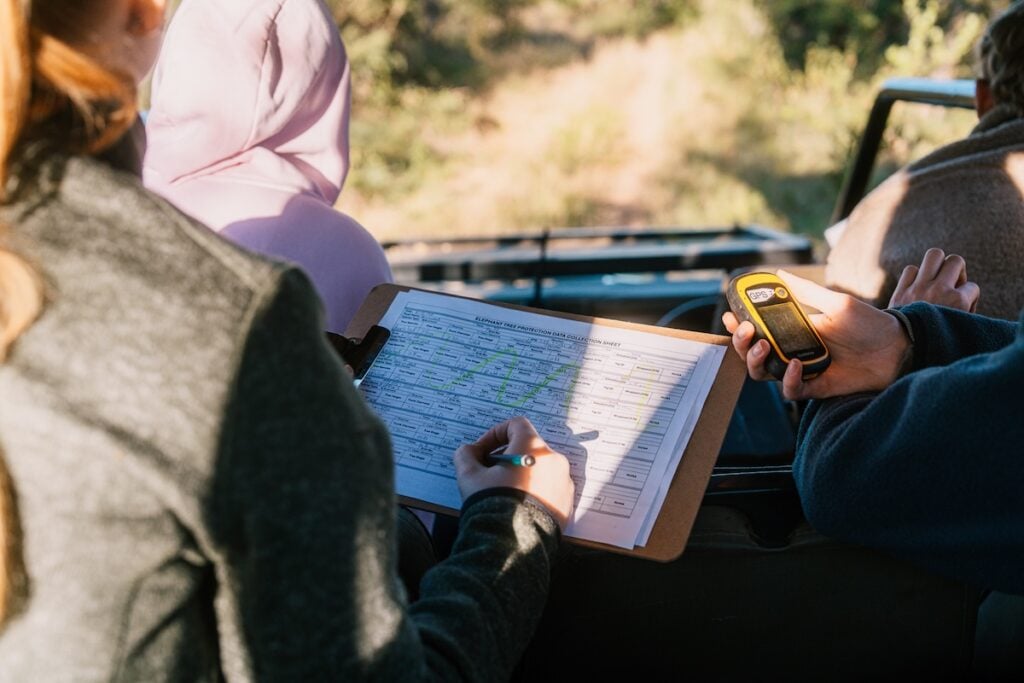
Each field session is followed by a structured data processing period back at the research station. Students work alongside the Research Manager to upload, sort, and validate the day’s observations — classifying camera trap images by species, entering GPS coordinates and behavioral records, processing vegetation transect data, and building the databases that underpin reserve management decisions.
This is where field science becomes usable science. Data quality directly determines what reserve ecologists can do with the results, so students learn to apply standardized protocols, check their own records for errors, and understand how individual observations connect to landscape-level questions: how are wildlife populations changing? Where is vegetation under pressure? Which areas are recovering?
Completed datasets are archived in the reserve’s central database and submitted to the ecologists responsible for adaptive management planning. Where appropriate, records are also contributed to national and global biodiversity platforms — including SABAP2 for bird data — so that the science produced at Mthimkulu reaches beyond the reserve fence.
Monthly monitoring data are reported to reserve management and, where appropriate, contributed to local, national and global conservation databases. An annual report brings together the year’s research, monitoring and conservation findings to support management and future research.
Join the program
School programs
Field-based ecological learning for high school and IB CAS groups.
University programs
Academic placements and faculty-led research groups mapping to US credit.
Individual volunteer programs
Independent placements for early-career conservationists and researchers.